
The Social Innovation
The DQ Institute is a think tank dedicated to setting global standards for digital intelligence to ensure the safety, empowerment, and well-being of individuals in the digital age.
The rapid digitalization of society has led to a phenomenon known as “infollution”, the pollution of our information environment. Today’s children are the first generation to be born and raised entirely in the hyper-connected AI-centric digital world, and they are frequently exposed to a range of digital dangers without adequate protection or guidance.
One of the key challenges in addressing these risks is the significant digital gap between children and adults. The ways in which children use technology differ greatly from those of their parents and educators, making it difficult for adults to fully grasp the risks and threats that young people encounter online. As a result, parents and educators often struggle to effectively teach children how to navigate digital technology and media safely.
Even though digital skills have become a core competency for children’s future success, digital education programs have not kept pace with this need and require substantial improvement. Furthermore, access to digital education remains uneven both within and between countries, deepening existing inequalities on a global scale.
The Institute’s core innovations include the development of universal frameworks and scalable tools for digital literacy, AI literacy, and child protection.
Magnitude of the Problem, and its Root Causes
The digital divide and lack of digital intelligence education expose children and societies to risks ranging from cyberbullying and misinformation to AI-driven inequalities. Billions lack access to structured digital literacy, and even where programs exist, there is little standardization or evidence-based practice.
Some of the key factors contributing to the magnitude of the problem include:
- Fragmented approaches to digital education across countries and sectors
- Lack of global standards and scalable, adaptable tools
- Insufficient policy prioritization and cross-sector collaboration
Based on their systems change analysis, the DQ Institute has made it a mission to develop and push for the adoption of global standards (digital literacy, AI literacy, and child protection) so that any country, educator, or parent may access high-quality, low-cost digital intelligence education, for all, especially children.
“Ashoka and the Globalizer program provided a rare space for civic sector leaders to step back from daily operations and think strategically, much like leaders in the corporate world. The process helped me reframe challenges, consider new perspectives, and connect with thought partners who continue to support me long after the program. That network and structured reflection have been invaluable resources on my journey.”
Strategy to Catalyze a Network of Changemakers towards the Targeted Mission
The DQ Institute’s strategy evolved from direct delivery of digital citizenship education to enabling global networks of changemakers through standards, platforms, and evidence. By positioning itself as a neutral infrastructure provider, DQ Institute empowers local actors—governments, educators, and organizations—to lead digital intelligence initiatives tailored to their contexts.
Some of the tactics they deployed towards the mission as a part of the strategy include:
1) Building Innovations, Evidence Generation and Open Knowledge Sharing to Inform & Involve Allies across Sectors
A core tactic has been the transparent and open sharing of research, data, and program models. DQ Institute publishes its methodologies, reports, and findings openly online, allowing others to learn from and build upon its work.
Some of these innovations include:
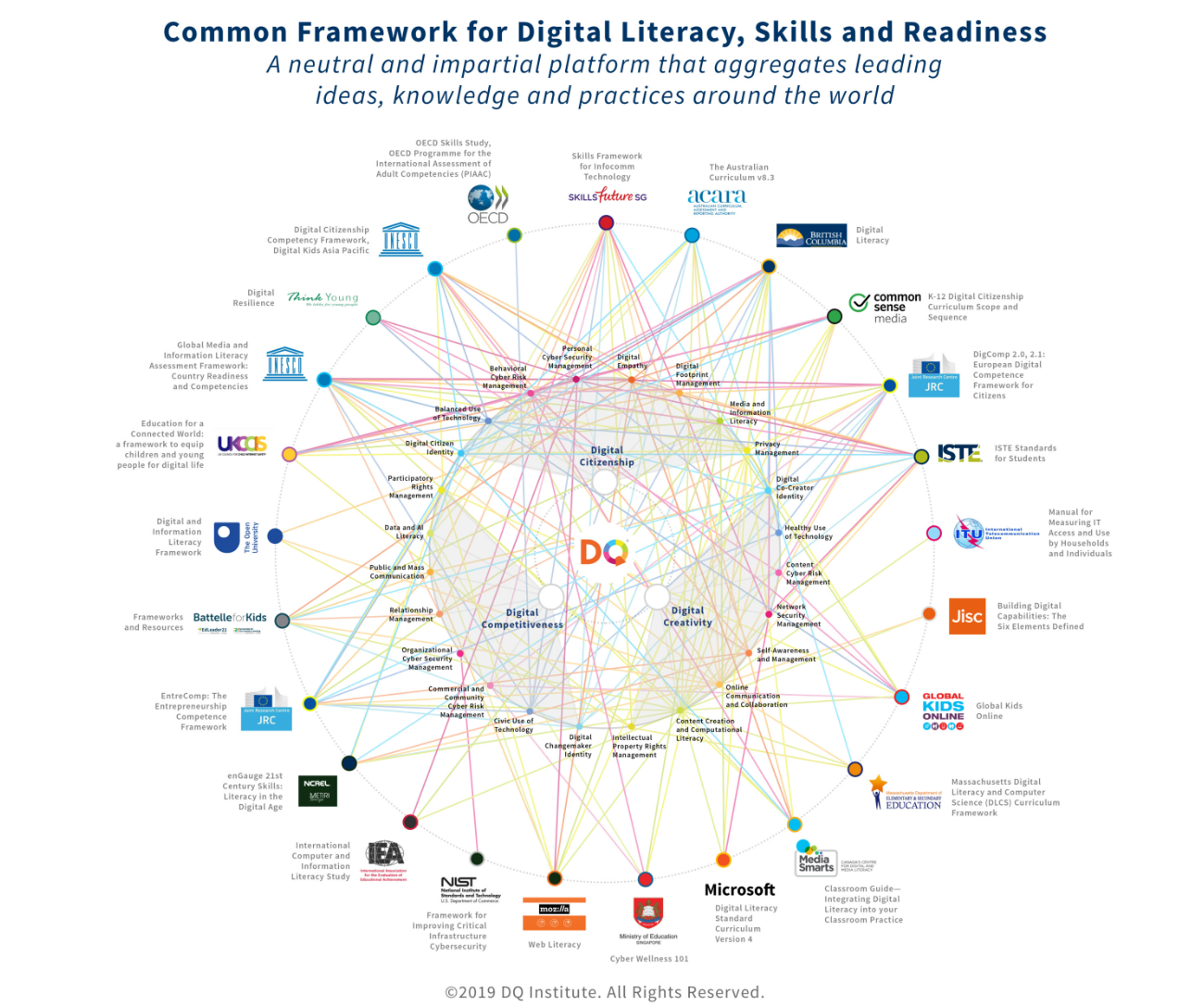
- DQ (Digital Intelligence): Beyond IQ and EQ, DQ (Digital Intelligence) represents critical skills needed to thrive in the digital age. DQ is defined as “a comprehensive set of technical, cognitive, meta-cognitive, and socio-emotional competencies that are grounded in universal moral values and that enable individuals to face the challenges and harness the opportunities of digital life.” Its framework aggregated across more than 100 prior leading frameworks about AI-digital literacy and skills. It lays out a common language, structure, and taxonomy around digital literacy, skills, and readiness that can be benchmarked, referenced, and adopted across nations and sectors worldwide.
- “Powered by DQ” AI-enabled platform: This innovative tool allows local partners—including NGOs, ministries of education, and private sector actors—to instantly design, adapt, and deliver their own digital intelligence curricula and assessments, aligned with 100+ frameworks at 1% cost. By lowering technical barriers and providing customizable content, the platform democratizes access to high-quality digital education and enables rapid localization. For example, partners in different countries have used the platform to create national toolkits and certification programs, tailored to their unique cultural and policy environments.
- Child Protection in Cyberspace Index: a global tool that measures and benchmarks countries’ efforts to safeguard children online. The Index, supported by the Global Cybersecurity Forum and funded by the Saudi Crown Prince Foundation, provides actionable insights for policymakers and has become a reference point for national and international strategies.
- AI Readiness Framework: a comprehensive assessment and benchmarking framework designed to help countries, organizations, and individuals evaluate and enhance their preparedness for the AI era. The tool assesses AI readiness across several key dimensions, including digital infrastructure, human capital, policy and governance, innovation ecosystems, and societal impact.
This openness has led to widespread replication—even by organizations and governments that do not formally partner with DQ Institute—and has established the Institute as a global thought leader in digital intelligence. Its data and frameworks are now referenced in international standards, government policies, and educational curricula across more than 100 countries.
2) Consulting & Collaborating with Partners to Spread Awareness, Catalyze Adoption & Advocate for Standardization
From the outset, DQ Institute recognized that technical solutions alone would not suffice—there needed to be a fundamental shift in how societies perceive digital intelligence and online safety. Yuhyun Park and her team strategically framed child protection as an urgent and universal issue, often referring to child cyber-risks as a “pandemic” that affects every child and community. and promoting AI-digital literacy as must-have human skills to address digital inclusion. Through global campaigns, high-profile partnerships, and persistent advocacy, DQ Institute has elevated digital intelligence from a niche educational topic to a core component of children’s rights and national development agendas.
DQ Institute has consistently prioritized a multi-stakeholder approach, convening diverse actors from government, academia, the private sector, and civil society. Rather than leading every initiative, the Institute acts as a facilitator and enabler—sharing tools, data, and expertise while encouraging local ownership. For instance, after supporting the creation of the DQ framework, DQ Institute stepped back to let local champions—such as ministries of education or national NGOs—take the lead in implementation and advocacy. This approach has fostered sustainable, context-driven change and built a “network of networks” that amplifies impact.
So far, they have worked with over 100 organizations in over 80 countries to implement their framework.
Their work has also included advising the World Economic Forum, G20 Civil Society, national governments, and global companies including TikTok, Snapchat, and Aramco with their policies on digital intelligence.
3) Co-creating Global Standards with Strategic Players for Institutionalization
During the 2018 World Economic Forum Sustainable Development Impact Summit in New York– the Organisation for Economic Co-operation and Development (OECD), the IEEE Standards Association and the DQ Institute announced their engagement in the Coalition for Digital Intelligence (CDI). The coalition is a platform for coordinating efforts on raising digital intelligence across the technology and education sectors and is supported by the World Economic Forum.
The DQ Institute spearheaded the development of the DQ Global Standards, which in 2020 were adopted by the IEEE as the world’s first international standard for digital literacy and digital intelligence. The Institute actively supported international organizations like the OECD and UN agencies and national governments in benchmarking the standards into policy and practice, ensuring widespread adoption and legitimacy.
DQ Institute’s current advocacy efforts include working with the Global Cybersecurity Forum in collaboration with ITU, UNICEF, and WeProtect to drive the adoption of Child Protection in Cyberspace Index globally. It serves as the checklist and assessment for nations to ensure to build a resilient national system to safeguard children online. The Index provides actionable insights for policymakers and has become a reference point for national and international strategies.
“What I realized while working on this is that there are lots of people who want to help and who want to work together. Often, I myself was the bottleneck to receiving help in the right way. It’s important to understand that you’re not alone—it’s actually better to work together and better to give than to take. Once we have that mindset, things get better in many ways.
It is important to avoid the “us vs them” and to objectively work with all the relevant allies to together look at the public health approach.
You can learn the most from people who criticize you.”
To dive deep into the process of on building the Digital Intelligence field and shifting mindsets around it, tune into Season 3, Episode 3 of the Ashoka Systems Change Podcast where Dr. Yuhyun Park shares about their journey.

For more than 40 years, Ashoka has built and nurtured a network of 4000+ leading social entrepreneurs in the world. Read more about the Ashoka Fellowship here.
- 2016,
The Globalizer strategy accelerator supports social entrepreneurs gain clarity on systemic root causes of social and environmental problems and the importance of engaging more changemakers as part of the solutions. It enables them to design effective collaborative systems change strategies (based on respect to all humans and nature).
Refined since 2010, the accelerator is a structured collective thinking and experimenting process between social entrepreneurs, systems thought partners from Ashoka and selected leaders from business and the social sector.
Participated with support from
Elements of the Collaborative Systems Change Strategy
Hover/Click on things to dive deepType of Root Cause identified as a Leverage Point for Systems Change (Donella Meadows)
The first element of crafting a collaborative systems change strategy to address a problem is to define the problem and identify the most strategic change needed to address the root cause(s) of the problem. That becomes the targeted Systems Change Goal or the Mission.
To identify it, analyze the root causes—barriers, factors, dynamics, points or conditions driving the problem—and determine which offers the greatest leverage for change.
According to the FSG, leverage points include:
- Policies
- Practices
- Resource Flows
- Relationships & Roles
- Power Dynamics
- Mental Models
These "leverage points" are derived from the work of Donella Meadows, the pioneer in the field of systems thinking who articulated and conceptualized "Leverage Points: Places to Intervene in a System to Create Effective Change".
Explore Case Studies of different types of "Systems Change Goal(s)" in our Library.
Endgame / Pathway applied towards Activating a Network of Changemakers towards the targeted Systems Change
The second element of crafting a collaborative systems change strategy includes determining how to achieve the systems change goal.
This means choosing a strategy suited to the system’s context. The strategy could be to:
- Work with government
- Create a new field/market
- Build a competitive advantage
- Shift societal narratives
The items on the list are neither mutually exclusive, nor collectively exhaustive.
You can read more about the types of systems change strategies/pathways/endgames/stories we have come across in this article by Odin Muehlenbein.
Explore Case Studies on different "Types of Strategy" in our Library.
Types of stakeholders activated as changemakers towards the systems change
The third element of crafting a collaborative systems change strategy includes identifying the critical stakeholders to activate as partners- those who influence an exponential number of people in the context of the system.
Irrespective of the type of strategy, systemic change always requires activation of a network of stakeholders for different tactics towards the mission.
Typical stakeholder groups for systemic change include:
- government agencies
- universities (e.g. education schools for the empathy paradigm, public health and med schools for the health paradigm, etc.)
- publishers (e.g. education publishers for empathy, medical journals for health, etc.)
- informal & formal communities / unions (e.g. AARP for longevity, teachers' unions for empathy, families, etc.)
- media companies
- industry-specific companies / organizations (e.g. tech companies and financial institutions for the technology paradigm, insurance and healthcare companies for longevity, relevant civil society organizations etc.).
Explore Case Studies on different "Types of Partners Engaged" in our Library.
The depths of engagements in play for the different stakeholders (CoCreative)
The fourth and final element of crafting a collaborative systems change strategy includes reflecting on what depth to engage with each stakeholder.
Activating a broad network is essential, but so is clarifying their role: Are they simply informed, consulted, or co-creating the strategy?
CoCreative's Five Levels of Engagement Framework guides how one may engage with each stakeholder. Are you:
- co-creating?
- collaborating?
- involving?
- consulting?
- informing?
Explore Case Studies on different "Levels of Stakeholder Engagement" in our Library.
Their work contributes towards


The 2030 Agenda for Sustainable Development, adopted by all United Nations Member States in 2015, provides a shared blueprint for peace and prosperity for people and the planet, now and into the future. At its heart are the 17 Sustainable Development Goals (SDGs), which are an urgent call for action by all countries - developed and developing - in a global partnership.
Explore Case Studies on strategies contributing to addressing different "SDGs" in our Library.
The root causes of global socio-ecological unsustainability their work is addressing (FSSD)
According to the Framework for Strategic Sustainable Development (FSSD) co-created by Ashoka Fellow Dr. Karl-Henrik Robèrt and Dr. Göran Broman and Dr. Merlina Missimer of the Blekinge Institute of Technology, Sweden, there are 8 root causes of all socio-ecological unsustainability problems (also referred to as Sustainability Principles):
- extraction from Earth's crust
- chemical pollution
- physical destruction
- barriers to health
- barriers to competence
- barriers to influence/participation
- barriers to impartiality
- barriers to meaning-making
To get a deeper feel, here are videos on the ecological and social sustainability principles.
You can see case studies of changemakers contributing to addressing different root causes ("Sustainability Principles") in our Library.