
The Social Innovation
National Association of Street Vendors of India (NASVI) was founded in 1998 to give voice and visibility to India’s street vendors, a group long marginalized and excluded from urban planning and social protection.
NASVI has built a national movement with 900 affiliates and over 1 million members across 25 states. Their early work focused on organizing street vendors into unions, advocating for legal recognition, and providing direct support during crises.
A major milestone was the successful advocacy for the Street Vendors (Protection of Livelihood and Regulation of Street Vending) Act, 2014, which for the first time recognized vendors’ rights in law. NASVI’s approach combined grassroots organizing, policy advocacy, and legal action, but was largely reactive and focused on government engagement and movement building among vendors themselves.
Magnitude of the Problem, and its Root Causes
Street vending is a critical part of India’s urban economy, with approximately 5 million street vendors—2% of any urban population—supporting 20 million dependents and contributing 11% of total urban employment. Despite operating sustainable businesses and serving as a path out of poverty, street vendors are regularly impacted by external interruptions that undermine their livelihoods.
During their participation in the Dela Program, co-created by Ashoka and IKEA Social Entrepreneurship in 2020, the NASVI team highlighted key factors that impact the businesses of street vendors: '
- Police harassment
- Evictions by police and municipalities
- Forcible seizure of goods by local authorities
- Most vendors lack certificates to vend
- Lack of survey, ID, licenses, and defined places to operate
- Lack of Town Vending Committees (TVCs)
- Often refused access to finance by the banking system
- Very slow constitution of Grievance Redressal Committees
Based on their systems change analysis, the NASVI team are on a mission to change the behavior patterns of the formal system (police, municipalities etc) towards street vendors by highlighting the current narratives through data and advocacy.
Strategy to Catalyze a Network of Changemakers towards the Targeted Mission
The strategy involves collecting and leveraging data to engage multiple stakeholders and shift the policy and public perception of the lived reality of the street vendors.
Some of the tactics they deployed towards the mission as a part of the strategy include:
1) Consulting and Involving Street Vendors with Evidence Collection
For years, NASVI and its network of street vendors had relied on anecdotal reports and qualitative stories to highlight the issue of police harassment. However, they realized that policymakers and authorities often dismissed these stories as isolated incidents or failed to grasp the scale of the problem. As one team member put it,
NASVI decided to conduct a systematic survey documenting the frequency and scale of police harassment and bribery in Delhi. The process was highly participatory and adapted to the realities of street vendors.
Rather than relying on online forms—which would have excluded many vendors—NASVI mobilized its frontline workers to conduct in-person interviews. This approach allowed for trust-building and more accurate responses, as the surveyors could explain the purpose and reassure vendors about confidentiality.
NASVI managed to survey 150–160 vendors in the pilot phase. The findings were stark and eye-opening:
- Harassment and Bribery: Over 90% of vendors reported regular harassment and bribery by police and municipal authorities—even those with official vending certificates.
- Financial Impact: Bribes typically amounted to 500 rupees or more per incident, sometimes equalling a vendor’s daily income. For some, bribery consumed 5–7% of their monthly earnings.
- Frequency: Many vendors reported paying bribes multiple times per month, with some facing demands as often as 6–10 times monthly.
- Perpetrators: The vast majority identified police as the main source of harassment, followed by municipal officials.
- Leadership Matters: Markets with strong vendor leaders saw significantly less harassment, highlighting the importance of local organization.
2) Collaborating with Media and Celebrity Chefs to Raise Public Awareness
NASVI publicized the data and shared stories of harassment through press releases and media outreach, resulting in increased coverage of street vendor issues and informed the greater public of the realities faced by street vendors.
They also launched the #VendingWithDignity campaign, collaborating with celebrity chefs and leveraging social media to reach over 4.4 million people. Used storytelling and crowdfunding to humanize vendors and mobilize public support.
3) Deploying Data-Driven Advocacy to Inform and Collaborate with Formal Institutions
Armed with this evidence,
- NASVI engaged with the Ministry of Housing and Urban Affairs, presenting their findings and pushing for stronger enforcement of vendor protections. The data made the problem undeniable and led to new ministry circulars instructing police not to harass certified vendors.
- The evidence supported NASVI’s legal actions, including a Supreme Court petition demanding better implementation of the Street Vendors Act.
- They pushed for the formation of Grievance Redressal Committees, as mandated by law, to provide vendors with a formal mechanism to report and resolve cases of police abuse.
- NASVI is working towards partnering with police institutions to make non-harassment of street vendors a core part of police identity, reinforced through specialized training and recognition. They are working on establishing effective dialogue mechanisms between street vendor advocacy groups and police at local, state, and national levels.
4) Collaborating with the Ministry of Housing and Urban Affairs to Recognize Street Vendors as part of the Formal System
Most vendors lacked official recognition, ID cards, or certificates, making it nearly impossible to access bank loans or government support. This forced many to rely on informal moneylenders who charged exorbitant interest rates, trapping vendors in cycles of debt and vulnerability, while continuing to face eviction and harassment from the police.
The COVID-19 pandemic brought these vulnerabilities into sharp focus. During this period, NASVI intensified its advocacy, highlighting the essential role vendors played in supplying food and goods even during the crisis. The organization wrote letters to ministries, engaged in public campaigns, and brought together vendor voices to demand urgent support.
In response to these pressures—and with NASVI’s persistent advocacy—the Government of India launched the PM Street Vendor’s AtmaNirbhar Nidhi (PM-SVANidhi) scheme. This national initiative aimed to provide working capital loans of up to ₹10,000 to street vendors, helping them restart their businesses and gain a foothold in the formal economy.
NASVI was not just a passive beneficiary of the scheme; it played an active role in shaping its design. During national conferences and direct dialogues with the Ministry of Housing and Urban Affairs, NASVI advocated for credit-based support rather than one-time grants, emphasizing the need for sustainable, long-term solutions. The organization’s data and stories from the ground helped convince policymakers that vendors needed formal recognition and access to credit.
By July 2022, over 6.5 million street vendors had received loans under PM-SVANidhi, with NASVI’s network playing a key role in outreach and facilitation. Vendors who received loans gained not only working capital but also formal recognition from the government and banks.
The NASVI team also helped more than 3 million street vendors get the Certificate of Vending.
These initiatives are helping shift their status from “illegal” to legitimate entrepreneurs. The schemes created a digital and financial footprint for vendors, opening doors to future credit, social security, and government benefits. The Ministry of Housing and Urban Affairs began to recognize vendors as part of the formal system, making it harder for authorities to evict or harass them.
5) Collaborate with Key Players to Equip and Involve Street Vendors to Decentralize Advocacy
NASVI now has up to 1.5 million street vendors as a part of their network and have launched an app to improve communication with members. The NASVI team
- trains vendor leaders to document incidents of harassment, submit complaints, and advocate for their rights at the local level.
- provide hands-on support, helping vendors fill out forms, upload documents, and navigate online portals.
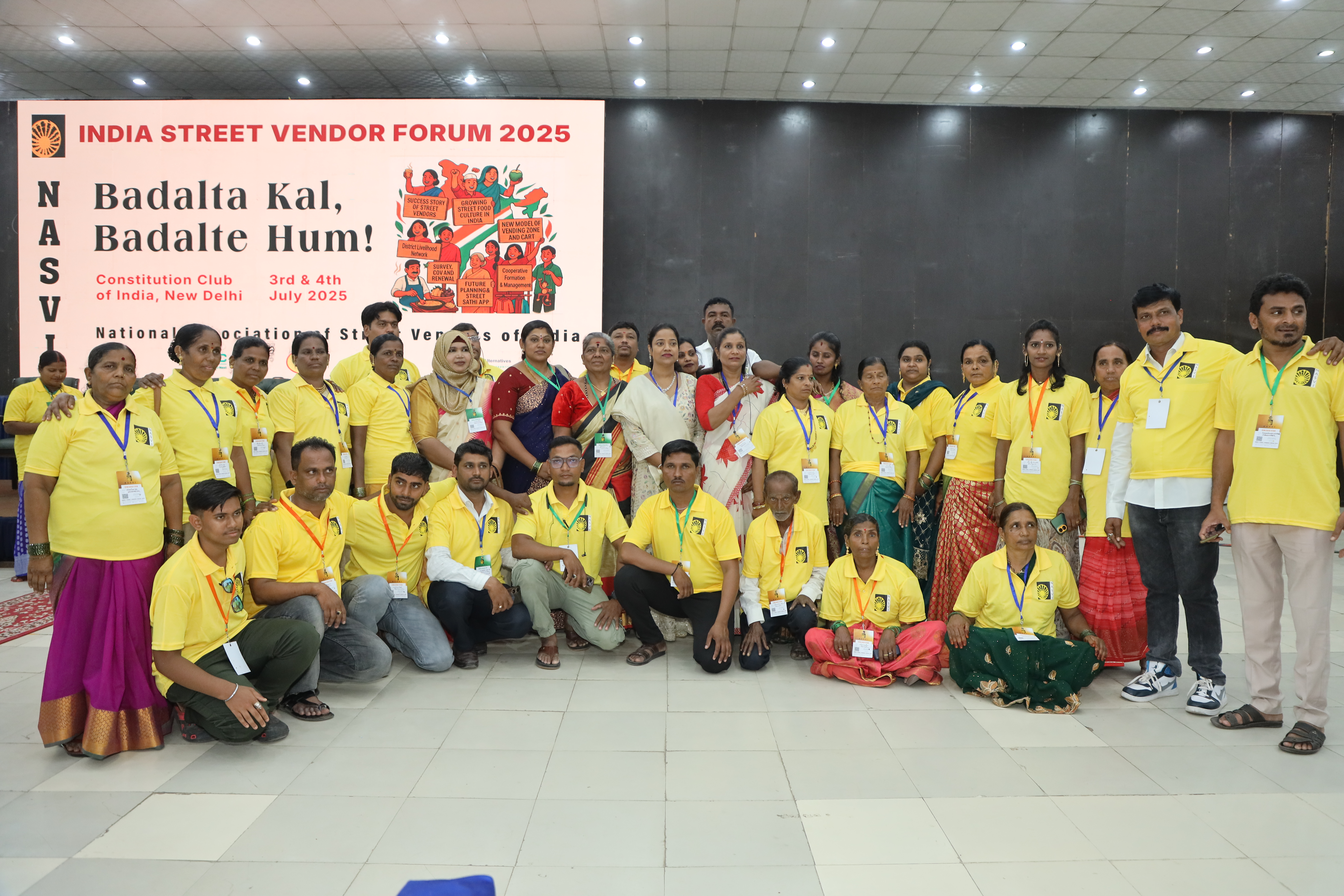
- collaborated with players like Development Alternatives, GAIL, ONGC to launch the Indian Street Vendors Forum to serve as a powerful platform for thousands of street vendors from across the country to come together, share their perspectives and address issues together.
At that time, we were more focused on changing the perspective of the municipality and administration and street vendors. We never thought about the general public... I think, you know, making the image of street vendors that they are also people who are trying to carry out their livelihood... that was more important. And I believe, you know, it’s not easy until someone from the ministry or from the higher ranking addresses it, but Globalizer helped us see the importance of public perception.
NASVI now plans to expand this model to other cities and states, incorporating baseline and endline surveys into all projects and using data to monitor the impact of public-facing campaigns.

For more than 40 years, Ashoka has built and nurtured a network of 4000+ leading social entrepreneurs in the world. Read more about the Ashoka Fellowship here.
- 2014,
- 2020,
The Globalizer strategy accelerator supports social entrepreneurs gain clarity on systemic root causes of social and environmental problems and the importance of engaging more changemakers as part of the solutions. It enables them to design effective collaborative systems change strategies (based on respect to all humans and nature).
Refined since 2010, the accelerator is a structured collective thinking and experimenting process between social entrepreneurs, systems thought partners from Ashoka and selected leaders from business and the social sector.
Participated with support from
Elements of the Collaborative Systems Change Strategy
Hover/Click on things to dive deepType of Root Cause identified as a Leverage Point for Systems Change (Donella Meadows)
The first element of crafting a collaborative systems change strategy to address a problem is to define the problem and identify the most strategic change needed to address the root cause(s) of the problem. That becomes the targeted Systems Change Goal or the Mission.
To identify it, analyze the root causes—barriers, factors, dynamics, points or conditions driving the problem—and determine which offers the greatest leverage for change.
According to the FSG, leverage points include:
- Policies
- Practices
- Resource Flows
- Relationships & Roles
- Power Dynamics
- Mental Models
These "leverage points" are derived from the work of Donella Meadows, the pioneer in the field of systems thinking who articulated and conceptualized "Leverage Points: Places to Intervene in a System to Create Effective Change".
Explore Case Studies of different types of "Systems Change Goal(s)" in our Library.
Endgame / Pathway applied towards Activating a Network of Changemakers towards the targeted Systems Change
The second element of crafting a collaborative systems change strategy includes determining how to achieve the systems change goal.
This means choosing a strategy suited to the system’s context. The strategy could be to:
- Work with government
- Create a new field/market
- Build a competitive advantage
- Shift societal narratives
The items on the list are neither mutually exclusive, nor collectively exhaustive.
You can read more about the types of systems change strategies/pathways/endgames/stories we have come across in this article by Odin Muehlenbein.
Explore Case Studies on different "Types of Strategy" in our Library.
Types of stakeholders activated as changemakers towards the systems change
The third element of crafting a collaborative systems change strategy includes identifying the critical stakeholders to activate as partners- those who influence an exponential number of people in the context of the system.
Irrespective of the type of strategy, systemic change always requires activation of a network of stakeholders for different tactics towards the mission.
Typical stakeholder groups for systemic change include:
- government agencies
- universities (e.g. education schools for the empathy paradigm, public health and med schools for the health paradigm, etc.)
- publishers (e.g. education publishers for empathy, medical journals for health, etc.)
- informal & formal communities / unions (e.g. AARP for longevity, teachers' unions for empathy, families, etc.)
- media companies
- industry-specific companies / organizations (e.g. tech companies and financial institutions for the technology paradigm, insurance and healthcare companies for longevity, relevant civil society organizations etc.).
Explore Case Studies on different "Types of Partners Engaged" in our Library.
The depths of engagements in play for the different stakeholders (CoCreative)
The fourth and final element of crafting a collaborative systems change strategy includes reflecting on what depth to engage with each stakeholder.
Activating a broad network is essential, but so is clarifying their role: Are they simply informed, consulted, or co-creating the strategy?
CoCreative's Five Levels of Engagement Framework guides how one may engage with each stakeholder. Are you:
- co-creating?
- collaborating?
- involving?
- consulting?
- informing?
Explore Case Studies on different "Levels of Stakeholder Engagement" in our Library.
Their work contributes towards



The 2030 Agenda for Sustainable Development, adopted by all United Nations Member States in 2015, provides a shared blueprint for peace and prosperity for people and the planet, now and into the future. At its heart are the 17 Sustainable Development Goals (SDGs), which are an urgent call for action by all countries - developed and developing - in a global partnership.
Explore Case Studies on strategies contributing to addressing different "SDGs" in our Library.
The root causes of global socio-ecological unsustainability their work is addressing (FSSD)
According to the Framework for Strategic Sustainable Development (FSSD) co-created by Ashoka Fellow Dr. Karl-Henrik Robèrt and Dr. Göran Broman and Dr. Merlina Missimer of the Blekinge Institute of Technology, Sweden, there are 8 root causes of all socio-ecological unsustainability problems (also referred to as Sustainability Principles):
- extraction from Earth's crust
- chemical pollution
- physical destruction
- barriers to health
- barriers to competence
- barriers to influence/participation
- barriers to impartiality
- barriers to meaning-making
To get a deeper feel, here are videos on the ecological and social sustainability principles.
You can see case studies of changemakers contributing to addressing different root causes ("Sustainability Principles") in our Library.


