The Social Innovation
The Sea Ranger Service is a social enterprise that bridges the gap between ocean conservation and youth employment.
Recognizing that only a fraction of the world’s protected marine areas is effectively managed, the organization created a scalable model that trains unemployed young people—often from coastal communities with high unemployment rates—as “Sea Rangers.”
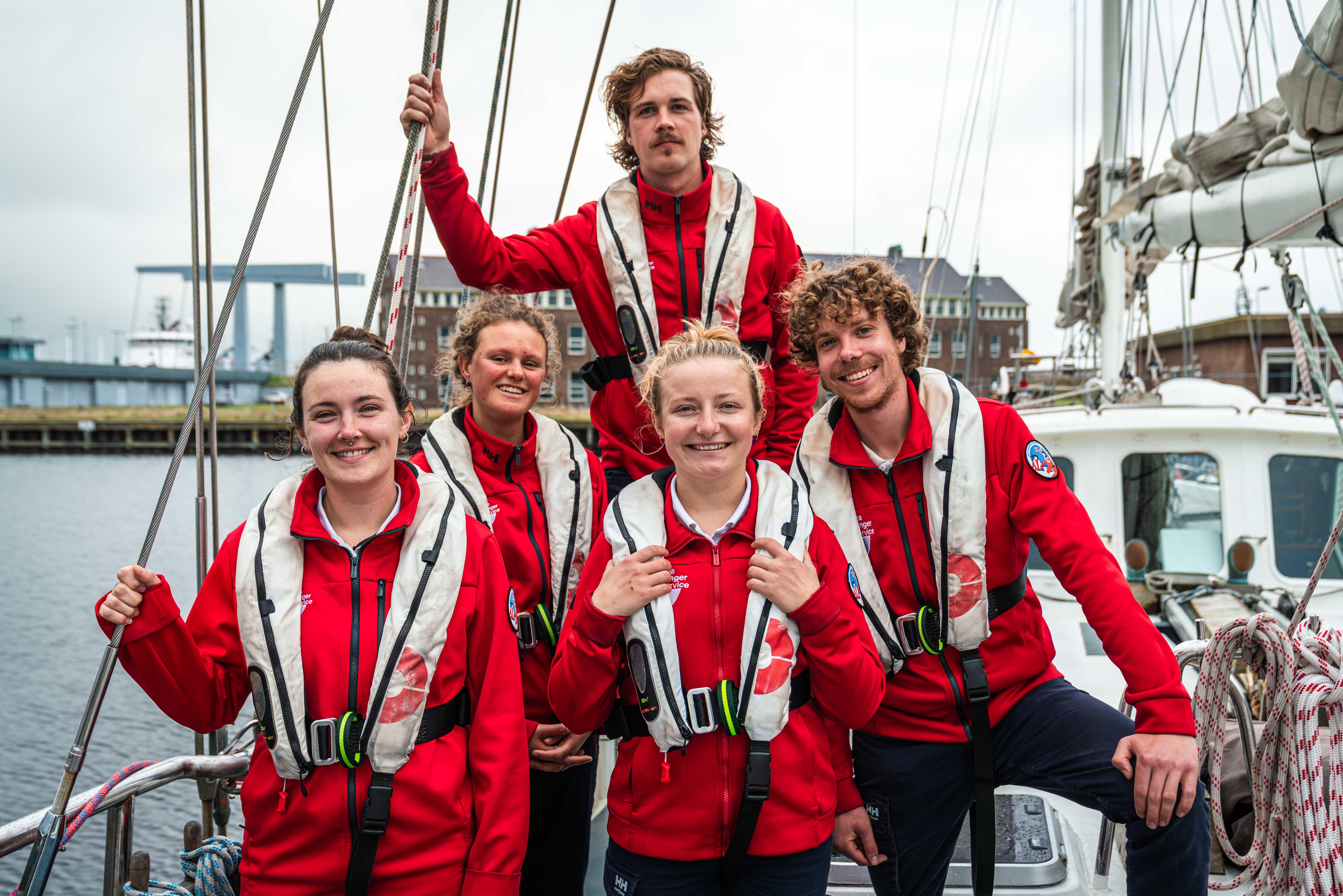
The Sea Ranger Service delivers contracted offshore environmental services using custom-built, low-emission sailing work ships operated by trained young people" Their core services include marine protected area monitoring and management, underwater landscape restoration (seagrass meadows and oyster reefs), environmental surveys for offshore wind farms, fisheries enforcement support, and various inspection and data collection tasks.
They work primarily under contract for government agencies (fisheries enforcement, coast guards, navy, port authorities) and commercial clients (offshore wind developers, retailers purchasing restoration credits, research institutions), operating on a revenue-generating business model where approximately 70% of income comes from contracted work, making ocean management financially self-sustaining while funding youth employment and career pathways into the maritime sector.
So far, they have had 208 young people in their programmes, with Sea Rangers now working in six countries in Europe, with plans to scale the model beyond.
Magnitude of the Problem, and its Root Causes
Oceans face existential threats from overfishing, pollution, and climate change. Although 7% of the world’s oceans are designated as protected areas, only 9% of these have adequate management. Without effective stewardship, conservation measures are rendered meaningless, biodiversity loss accelerates, and coastal communities suffer from declining fisheries and rising unemployment. Meanwhile, the maritime sector faces a shortage of 90,000 recruits by 2026, even as youth unemployment in some coastal communities can reach up to 30%.
During their participation in the Dela Program co-created by Ashoka and IKEA Social Entrepreneurship in 2019, the Sea Ranger Service team highlighted the following key factors contributing to the magnitude of the problem:
- Perception of Ocean Management as a Cost Center: Political commitment is low because ocean management is seen as expensive and offering limited socioeconomic benefit.
- Lack of Capacity and Innovation: Traditional, motorized offshore vessels are costly and unsustainable; there is little innovation or private sector involvement in marine management.
- Disconnected Social and Environmental Challenges: High youth unemployment and the need for ocean restoration are rarely addressed together, missing an opportunity for mutual benefit.
Based on their systems change analysis, the Sea Ranger Service team made it a mission to make "Sea Ranger" a recognized maritime profession that adds cost-effective human capacity for marine management (and the conservation sector) while creating employment pathways for unemployed youth.
"What was so valuable was that it really got us thinking through the systems change lens. That totally changed it from 'we're focused on developing a product' to us thinking much more broadly. In a way we slowed down to allow ourselves to think much more structured about the system. It’s clear that ultimately—even though it takes much longer—is what has made us successful.
Strategy to Catalyze a Network of Changemakers towards the Targeted Mission
The strategy involves creating a market for the "Sea Rangers” profession for marine management (and the conservation sector as a whole).
Some of the tactics they deployed towards the mission as a part of the strategy include:
1) Collaborating & Involving Partners across Sectors to Establish Maritime Industry Standards for Low-Emission Vessels Co-created with Shipbuilders
"Green alternatives" typically mean compromises—lower performance, higher costs, or regulatory exceptions. The Sea Ranger Service rejected this paradigm, committing to wind-powered work ships that met or exceeded all existing commercial maritime standards. This required seven years working with the Dutch Shipping Inspectorate to establish an entirely new commercial vessel classification. The result: sailing work ships fully certified for commercial operations, achieving 94.3% fuel reduction and 94.4% CO2 reduction compared to motorized vessels.
The breakthrough was proving these vessels aren't "green alternatives"—they're legitimate commercial work ships that happen to be dramatically cleaner. The organization never asked for regulatory exceptions. Partnering with established shipbuilders—companies that build commercial vessels—provided crucial credibility.
The new vessel classification creates infrastructure for the entire maritime industry to get involved:
- Other shipbuilders can now design vessels to this standard;
- Government agencies can specify this vessel type in procurement;
- Insurance companies have frameworks for coverage.
The organization encourages wider adoption of this new type of work vessel. Specific design aspects of the Sea Ranger vessels are proprietary, but the classification standard enables market-wide adoption.
Two operational ocean-going vessels have proven capability across 32 contracts, shifting maritime procurement conversations from "nice to have" to "quality offshore delivery."
2) Collaborating with Influential Players to Legitimize Sea Rangers as a New Profession
The fundamental challenge was overcoming the deeply conservative maritime sector's assumption that ocean management requires career professionals with traditional credentials.
The legitimacy-building strategy was deliberate and multi-layered, and deliberately targeted the most traditional institutions.
The breakthrough came in 2018 when four Dutch government ministers collectively signed a contract with the Sea Ranger Service, instructing civil servants across fisheries enforcement, cultural heritage, and environmental agencies to explore collaborations. Over the first few years, the high-level mandate took time towards adoption. The Dutch fisheries enforcement agency was one of the first, with the Royal Netherlands Navy—one of the old maritime institutions—committed to engaging the Sea Ranger Service after seven years successful deployment at sea.
"You come into these maritime circles—it is traditional and it takes time to take people along into a new way of working. There is limited innovation, given the natural shortage of capacity, which is of course why we bring our solution. But at the same time, it's a world where your intervention needs to be genuinely good before it gets adopted."
Navy veterans—not environmental advocates—train Sea Rangers through annual bootcamps emphasizing discipline and safety.
Collaborating with the Navy to develop a new type of national training curriculum for Sea Rangers which would be embedded in the national college system. This work is ongoing, with the Dutch and Welsh governments recently committing funding for this work.
Securing a multi-year framework contract with the Port of Rotterdam—the largest industrial port in the Northern Hemisphere—provided both revenue stability and crucial credibility with the maritime industry.
Queen Máxima of the Netherlands christened the flagship low-emissions vessel SRS Janet Taylor in April 2025, which signalled highest-level national recognition. "With the Queen’s presence confirmed, many directors of offshore companies attended too. It created a moment where everyone can be involved with something new and innovative."
They strategically targeted South Wales for UK expansion—a region with high levels of youth unemployment, where The Crown Estate (responsible for managing UK seabed) wanted to demonstrate that offshore wind development benefits coastal communities. Sea Ranger Service offered the perfect solution: offshore work capacity plus youth employment. Within 2.5 weeks of the Crown Estate contracting them for offshore surveys, over 300 young people applied. Six months later (November 2024), the Sea Rangers were welcomed into the House of Lords for special cross-party recognition.
By early 2026, the organization had delivered on 32 contracts across 6 European countries (Netherlands, UK, France, Spain, Germany, Denmark) —25 with government agencies, with 23 for work agencies had never contracted externally before. The Royal Netherlands Navy partnership evolved to deeper institutional integration, with first-year Navy recruits now spending four months sailing on Sea Ranger ships during training.
"Sea Ranger" is becoming a recognized maritime profession—a legitimate career path, not volunteer activism.
3) Collaboration with the UK Crown Estate leading to Institutionalization of the approach
The Crown Estate contracted Sea Rangers for offshore surveys with explicit youth employment requirements. The Crown Estate has long realized the potential for sector-wide implementation towards more social value outcomes.
Alongside the work with the Sea Ranger Service, The Crown Estate strengthened their policy requiring all offshore wind developers to employ young people Not in Employment, Education or Training (NEETs) for 10% of their workforce.
"There was a noticeable change from people tapping me on the shoulder sympathetically for the social impact initiative to reaching out for commercial support instead. It went from a sympathetic initiative to a market driver. For multi-million offshore wind farm developments, a differentiating factor for procurement bids can now come from the social impact as we create tangible offshore skills training and career prospects for local communities. This represents genuine institutionalization—with such policies operating independently of Sea Ranger Service. Even if our organization ceased operations tomorrow, the requirement remains, creating permanent infrastructure for connecting coastal youth employment with offshore industry in the UK.”
As of early 2026, the Sea Ranger Service has 17 offshore companies directly engaged to explore ways to deliver on the social value criteria.
4) Creating Dedicated Financing Infrastructure Through Sea Ranger Impact Fund
Maritime work is extraordinarily capital-intensive—millions of euros per vessel, long construction timelines, seasonal cash flow gaps. Traditional social enterprise financing doesn't accommodate this: philanthropic grants rarely cover capital assets at scale, impact investors avoid highly capital-intensive models, and banks won't finance social enterprises without extensive collateral. This financing gap threatened to limit systems change impact regardless of operational success.
In April 2025, the organization announced the Sea Ranger Impact Fund—a dedicated investment fund structured for the unique capital requirements of the model.
The fund supports not only Sea Ranger Service but future franchises and affiliated companies adopting the model, transforming the financing from organizational infrastructure to systems infrastructure.
5) Collaborating with Partners to Leverage & Replicate the Ranger Model Across Sectors
A critical moment came when universities developing seagrass restoration methodologies approached Sea Ranger Service in 2021. They had the methods to restore seagrass at scale but only had students and volunteers to do this work.
"There is all numerous climate mitigation and ecological restoration solutions where there is the policy, sometimes we even have the innovation and the money, but the capacity, the infrastructure to implement this in much larger scale, that's lacking. It requires boots on the ground."
This validated a broader hypothesis: the Ranger model works wherever there's important climate/conservation work needing doing, technical methodologies developed, insufficient capacity to implement at scale, and young people seeking purposeful careers.
The Ranger model is starting to be leveraged in different contexts like seagrass and oyster reef restoration. The Sea Rangers team collaborated with the University of Groningen, L'Office Français de la Biodiversité (OFB), Institute of Environmental Hydraulics of Cantabria (IH Cantabria), The Mediterranean Institute for Advanced Studies (IMEDEA-CSIC-UIB) and the French GIPREB to deploy Sea Rangers for restoration work, and within one year, retailers including Nestlé, and more recently Tesco, became paying clients The organization now holds permits in six countries to collect seagrass seeds for transplanting across borders—creating restoration supply chains that couldn't exist with volunteer-dependent models.
"Sea Ranger" is one expression of broader systems innovation—creating infrastructure to connect young people seeking purposeful work with climate/conservation capacity gaps. This cross-sector replication potential proves the model's universality, creates youth career pathways across sectors, enables international replication, attracts broader political support, and builds movement identity where being a “Ranger" becomes recognized identity for young climate professionals.
"Climate, biodiversity, nature—all of these things are so abstract. It's always about statistics and policy and science. So to most people, it's very difficult to engage with that. The moment you give it a human face and it becomes something where young people as young professionals can get a sense of pride and identity about being a Ranger and being on the front lines of climate change doing this work—even traditionally less conservation-focused politicians get on board because it's about young people, new jobs and seeing the next generation making a difference for the future."
For more than 40 years, Ashoka has built and nurtured a network of 4000+ leading social entrepreneurs in the world. Read more about the Ashoka Fellowship here.
- 2019,
The Globalizer strategy accelerator supports social entrepreneurs gain clarity on systemic root causes of social and environmental problems and the importance of engaging more changemakers as part of the solutions. It enables them to design effective collaborative systems change strategies (based on respect to all humans and nature).
Refined since 2010, the accelerator is a structured collective thinking and experimenting process between social entrepreneurs, systems thought partners from Ashoka and selected leaders from business and the social sector.
Participated with support from
Elements of the Collaborative Systems Change Strategy
Hover/Click on things to dive deepType of Root Cause identified as a Leverage Point for Systems Change (Donella Meadows)
The first element of crafting a collaborative systems change strategy to address a problem is to define the problem and identify the most strategic change needed to address the root cause(s) of the problem. That becomes the targeted Systems Change Goal or the Mission.
To identify it, analyze the root causes—barriers, factors, dynamics, points or conditions driving the problem—and determine which offers the greatest leverage for change.
According to the FSG, leverage points include:
- Policies
- Practices
- Resource Flows
- Relationships & Roles
- Power Dynamics
- Mental Models
These "leverage points" are derived from the work of Donella Meadows, the pioneer in the field of systems thinking who articulated and conceptualized "Leverage Points: Places to Intervene in a System to Create Effective Change".
Explore Case Studies of different types of "Systems Change Goal(s)" in our Library.
Endgame / Pathway applied towards Activating a Network of Changemakers towards the targeted Systems Change
The second element of crafting a collaborative systems change strategy includes determining how to achieve the systems change goal.
This means choosing a strategy suited to the system’s context. The strategy could be to:
- Work with government
- Create a new field/market
- Build a competitive advantage
- Shift societal narratives
The items on the list are neither mutually exclusive, nor collectively exhaustive.
You can read more about the types of systems change strategies/pathways/endgames/stories we have come across in this article by Odin Muehlenbein.
Explore Case Studies on different "Types of Strategy" in our Library.
Types of stakeholders activated as changemakers towards the systems change
The third element of crafting a collaborative systems change strategy includes identifying the critical stakeholders to activate as partners- those who influence an exponential number of people in the context of the system.
Irrespective of the type of strategy, systemic change always requires activation of a network of stakeholders for different tactics towards the mission.
Typical stakeholder groups for systemic change include:
- government agencies
- universities (e.g. education schools for the empathy paradigm, public health and med schools for the health paradigm, etc.)
- publishers (e.g. education publishers for empathy, medical journals for health, etc.)
- informal & formal communities / unions (e.g. AARP for longevity, teachers' unions for empathy, families, etc.)
- media companies
- industry-specific companies / organizations (e.g. tech companies and financial institutions for the technology paradigm, insurance and healthcare companies for longevity, relevant civil society organizations etc.).
Explore Case Studies on different "Types of Partners Engaged" in our Library.
The depths of engagements in play for the different stakeholders (CoCreative)
The fourth and final element of crafting a collaborative systems change strategy includes reflecting on what depth to engage with each stakeholder.
Activating a broad network is essential, but so is clarifying their role: Are they simply informed, consulted, or co-creating the strategy?
CoCreative's Five Levels of Engagement Framework guides how one may engage with each stakeholder. Are you:
- co-creating?
- collaborating?
- involving?
- consulting?
- informing?
Explore Case Studies on different "Levels of Stakeholder Engagement" in our Library.
Their work contributes towards

The 2030 Agenda for Sustainable Development, adopted by all United Nations Member States in 2015, provides a shared blueprint for peace and prosperity for people and the planet, now and into the future. At its heart are the 17 Sustainable Development Goals (SDGs), which are an urgent call for action by all countries - developed and developing - in a global partnership.
Explore Case Studies on strategies contributing to addressing different "SDGs" in our Library.
The root causes of global socio-ecological unsustainability their work is addressing (FSSD)
According to the Framework for Strategic Sustainable Development (FSSD) co-created by Ashoka Fellow Dr. Karl-Henrik Robèrt and Dr. Göran Broman and Dr. Merlina Missimer of the Blekinge Institute of Technology, Sweden, there are 8 root causes of all socio-ecological unsustainability problems (also referred to as Sustainability Principles):
- extraction from Earth's crust
- chemical pollution
- physical destruction
- barriers to health
- barriers to competence
- barriers to influence/participation
- barriers to impartiality
- barriers to meaning-making
To get a deeper feel, here are videos on the ecological and social sustainability principles.
You can see case studies of changemakers contributing to addressing different root causes ("Sustainability Principles") in our Library.